Power, Consent, and the Long Road to Justice in Ukraine

Updated: Sep 30
Author: JK
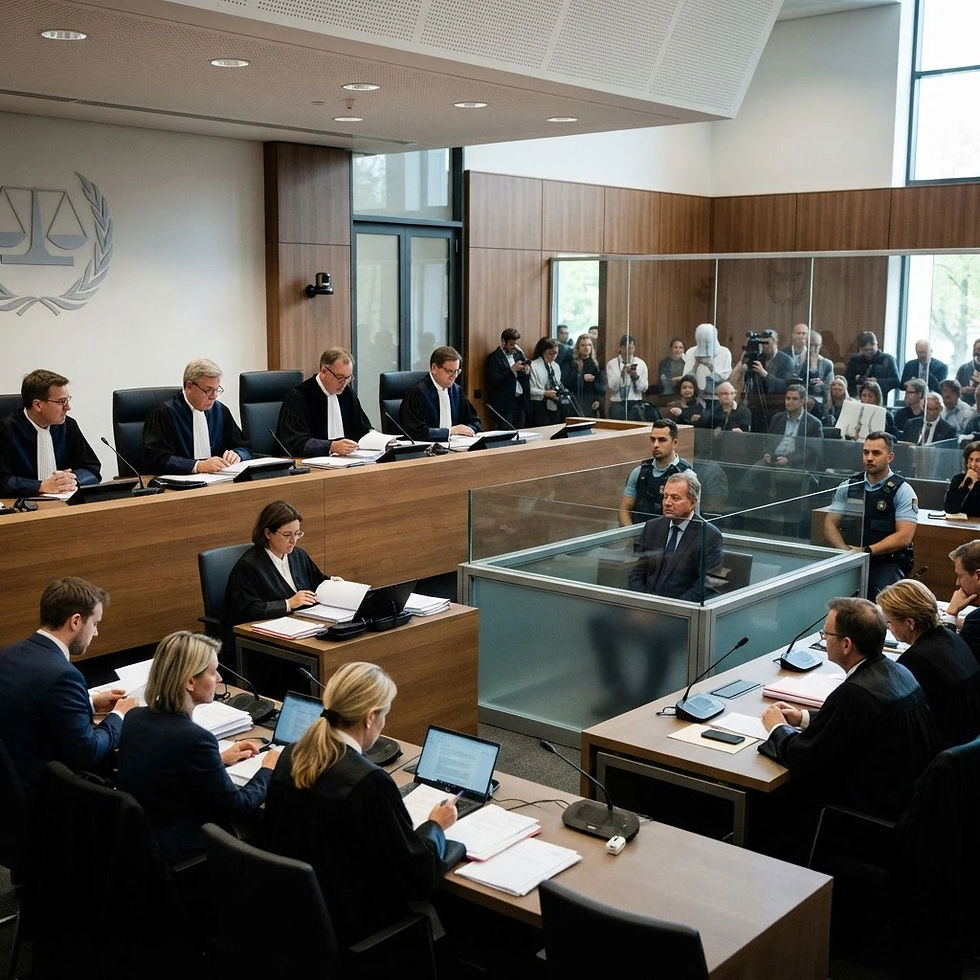
On March 17, 2023, the International Criminal Court (“ICC”) issued an arrest warrant for Vladimir Putin, marking the first time it has indicted a sitting head of state from a permanent member of the UN Security Council (“UNSC”).[i] The warrant for the Russian president was one of the boldest moves in the Court’s history, however, it also reflects the core question of international criminal law (“ICL”): in a system that relies on state cooperation to turn warrants into arrests, can accountability ever be more than aspirational?
Introduction
As is commonly said in global conflicts: the world is watching. Indeed, this has been the case since the Russian annexation of Crimea in 2014 and, more prominently, Russia’s invasion of Ukraine on February 24, 2022.[ii] Like Myanmar, the situation in Ukraine has become a high-stakes test for the ICC and more broadly, ICL as a whole. Unlike the legal ingenuity of the ICC’s investigation into Myanmar, however, the situation in Ukraine has featured the opposite characteristic of political cooperation. While the ICC has certainly benefited from increased participation and evidence gathering capability, it continues to face enforceability problems, begging the same old questions about ICL that have plagued Myanmar. Yet, many see the situation as a step forward because it involves the investigation of one of the world’s geopolitical hegemons. As such, this blog addresses the ICC’s investigation into crimes committed in Ukraine, longstanding criticisms of the ICC’s “Western bias,” and concludes by contrasting Ukraine with Myanmar.
From its creation in Nuremberg and Tokyo to Yugoslavia, Rwanda, and Myanmar, ICL now faces a new test in Ukraine.
Background: Jurisdiction and Scope
Neither Russia nor Ukraine were State Parties to the Rome Statute when their conflict began in 2014.[iii] While this would ordinarily preclude ICC intervention, the Ukrainian government enacted two Article 12(3) declarations in 2014 and 2015 which granted the ICC jurisdiction over the crimes in Ukrainian territory going back to November 21, 2013.[iv] While Ukraine officially became a State Party on January 1, 2025, the second 2015 declaration had no cut-off date and thus also covers crimes that have been committed due to the 2022 invasion.[v]
The ICC has jurisdiction over three of the four core international crimes committed in Ukraine, namely war crimes, crimes against humanity, and genocide.[vi] The exception is the crime of aggression, which is defined in the Rome Statute (“Statute”) as “the planning, preparation, initiation or execution, by a person in a position…[with effective] control over…a State, of an act of aggression which…constitutes a manifest violation of the Charter of the United Nations.”[vii] In applying this definition to the conflict, much of the Russian military’s actions, directed under their senior leadership, fall under this definition as the invasion itself was a manifest act of aggression. Nevertheless, Article 15 bis (5) of the Statute declares that the ICC has no jurisdiction over the crime of aggression when it is committed by the nationals of, or on the territory of, a Non-State Party, so Russian leaders cannot be prosecuted by the Court for the crime.[viii] The only other possible exception to prosecuting the leaders of Non-State Parties for the crime of aggression is a referral from the UNSC, which is essentially impossible due to Russia’s permanent veto.[ix] Resultantly, the ICC is restricted to the aforementioned three core crimes of war crimes, crimes against humanity, and genocide, when investigating Russian leaders.
The preliminary ICC examination, which was completed in December 2020 prior to the 2022 invasion, found a reasonable basis to believe that a wide range of war crimes and crimes against humanity had been committed, reaching the requisite level of gravity.[x] Despite this finding, no authorization for the investigation was sought from the Pre-Trial Chamber in the course of 2021.[xi]
The Investigation Begins
Only four days after Russia’s invasion on February 28, 2022, ICC Prosecutor Karim Khan announced his decision to proceed with opening an investigation in Ukraine.[xii] The investigation commenced swiftly due to referrals by 39 States Parties (later joined by additional states for a total of 43), comprising an unprecedented number of referrals.[xiii] This referral mechanism bypassed the need for the Prosecutor to seek a lengthy judicial authorization from the Pre-Trial Chamber under Article 15(3) of the Statute and allowed for immediate investigation.[xiv]
Both Ukrainian and Russian officials have stated that thousands of children have been transferred from Ukraine to Russia since the beginning of the invasion.[xv] While the numbers are impossible to verify, as of end of February 2023, the government of Ukraine indicated that 16,221 children had been deported.[xvi] The Russian Federation is allegedly creating a system of assimilation for these children, including the granting of Russian citizenship and the placement of children in foster families.[xvii] These actions marked the basis of the first ICC arrest warrants on March 17, 2023, by Pre-Trial Chamber II, against two individuals: Vladimir Putin, the President of the Russian Federation, and Maria Lvova-Belova, the Commissioner for Children’s Rights in the Office of the President.[xviii] Specifically, the charges relate to the war crimes of unlawful deportation of population (Article 8(2)(a)(vii)) and the unlawful transfer of population (Article 8(2)(b)(viii)), focusing on crimes against children.[xix] Lvova-Belova even blatantly stated in July 2022 that, “now that the children have become Russian citizens, temporary guardianship can become permanent.”[xx]
The warrant against Putin marked the first ICC warrant issued for a sitting Head of State outside of Africa.[xxi] President Putin is alleged to bear criminal responsibility not only as a direct perpetrator but also pursuant to the doctrine of superior responsibility under Article 28(b) of the Statute, which essentially holds a civilian leader responsible for failing to take necessary measures to prevent the relevant crimes being committed.[xxii] Since then, four additional charges have been brought against military leaders Sergei Kobylash, Viktor Sokolov, Sergei Shoigu, and Valery Gerasimov.[xxiii] They are alleged to have committed the war crime of directing attacks at civilian objects (Article 8(2)(b)(ii)), the war crime of causing excessive incidental harm to civilians or damage to civilian objects (Article 8(2)(b)(iv)), and the crime against humanity of inhumane acts (Article 7(1)(k)).[xxiv]
These developments demonstrate that the ICC can act decisively when political alignment and evidentiary access are on its side. Decisive or not, however, the arrest warrants and corresponding lack of arrests expose the age-old limits of ICL, where warrants alone cannot secure arrests, and even the most thorough investigations remain subject to state cooperation. As such, Ukraine provides the ICC with both its greatest opportunity and its most visible test as it is a chance to prove that justice can function amid the pressures of global power politics.
The Western Bias Narrative
The large-scale mobilization for justice in Ukraine follows decades of criticism directed at ICL and, in particular, the ICC. For years, the ICC has faced criticisms that it was “targeting Africans”[xxv] and that the Court amounted to “judicial neo-colonialism.”[xxvi] These allegations gained traction during the ICC’s first decade, when its early caseload was exclusively African nations, from Sudan, Uganda and the Democratic Republic of the Congo to the Central African Republic, Kenya, and Libya.[xxvii] Moreover, as of 2026, all of the ICC’s six convictions for core international crimes are for African individuals.[xxviii]
These concerns are contextualized within a broader critique of double standards in international criminal justice. Critics argue that while the ICC has focused its prosecutorial efforts on African leaders, it has failed to meaningfully investigate core international crimes allegedly committed by individuals from powerful states such as the United States, China, or Russia.[xxix] The persistence of this perception is reinforced by the fact that these three states, who are permanent members of the UNSC, are not even parties to the Statute that established the ICC.[xxx] This means that international crimes committed in their territories are not subject to ICC jurisdiction unless, as said, the UNSC refers the situation, an unlikely outcome given its members veto power.[xxxi] China, for example, has blocked UNSC action on Myanmar and would likely veto any action regarding its own record in Xinjiang or Tibet; likewise, Russia has blocked resolutions on Ukraine, and the United States would likely oppose scrutiny over its own military conduct in Afghanistan, Iraq, or elsewhere.[xxxii] Consequently, powerful non-member states remain insulated from ICC scrutiny while simultaneously having the power to obstruct or push ICC investigations, whereas African states lack the comparable political capital to shield themselves.
The pattern of ICC engagement lends credence to the appearance of asymmetry. Until recently, nearly all situations under ICC investigation concerned states classified as developing countries.[xxxiii] Even in Georgia, the ICC’s first non-African investigation, no arrest warrants were issued until after the 2022 invasion of Ukraine, six years after the investigation opened in 2016.[xxxiv] When viewed in isolation, these statistics and political dynamics make the Western bias narrative appear facially plausible. As the following sections demonstrate, however, this interpretation ignores the structural limits of ICC jurisdiction, cooperation, and enforcement, and it is these geopolitical constraints, not Western bias, that ultimately explain disparities in the Court’s work.
Ukraine: Rebutting and Reinforcing the Narrative
The Ukraine crisis provides a test case that both rebuts and reinforces the narrative of Western bias. The ICC’s decision to open an investigation and issue arrest warrants against top Russian leadership, including a sitting President, demonstrates that the ICC can take on a major power and UNSC member. Many have seen the ICC’s swift action as a welcome opportunity to rebalance the scales of justice and a sign that the ICC could, at least in principle, confront violations regardless of geopolitical stature.[xxxv] Yet accountability efforts rely heavily on Western support, which in turn implies dependency. Moreover, following Russia’s invasion, the record number of state referrals and the unprecedented financial and logistical support from Western governments are cited by critics as evidence of a “two-tiered system of justice,”[xxxvi] in which the Office of the Prosecutor might “gravitate towards situations [like Ukraine] that powerful western states are willing to throw additional resources”[xxxvii] at. To some, the Court’s effectiveness, in this sense, mirrors rather than transcends global inequalities.
While some may say this rapid mobilization of political support has exposed the underlying political calculations and double standards in the international justice system, it points towards a simpler reality that attention goes where money flows. Russia’s invasion of Ukraine was one of the most blatant violations of international law in the last few decades. While it is an unfortunate reality that African conflicts do not receive similar media attention, the Ukrainian conflict has taken on much larger geopolitical dimensions than those in South Sudan or the Tigray region.[xxxviii] But why is the Ukrainian conflict more important geopolitically? For one, it involves a major power, but it also features a tremendous amount of natural resource exchange as Russia was the traditional supplier of oil to Europe (Russia supplied the EU with 45 percent of its gas and 27 percent of its oil in 2021).[xxxix] What’s more, the Russian invasion is the first European conflict since the Yugoslav wars and unfolded on a continent that still defines much of the international legal order. While all these points play a role, the main reason for a seemingly united and unprecedented response to Russian crimes in Ukraine point to the inter-state nature of the invasion, rather than intra-state conflicts common in Africa and Asia.[xl] As professors Anjali Dayal and Kate Cronin-Furman argued, “Russia’s invasion has created victims the world recognizes”[xli] because “violence among states is easier to acknowledge than internal brutality.”[xlii] It must be said, moreover, that these factors do not justify the asymmetry of response, but rather explain it.
Many of the Ukraine-related critiques centre around the idea that there has been too little of the ICC in Africa, yet before the conflict, it was “too much ICC in Africa.”[xliii] This sudden pivot reveals the reality that the ICC, like all international institutions, operates within constraints of politics, funding, and attention. Whatever path it takes, the Court will be criticized as either overreaching or neglectful. At least in Ukraine, arrest warrants have been issued, and the response has been swift.
Comparison with Myanmar
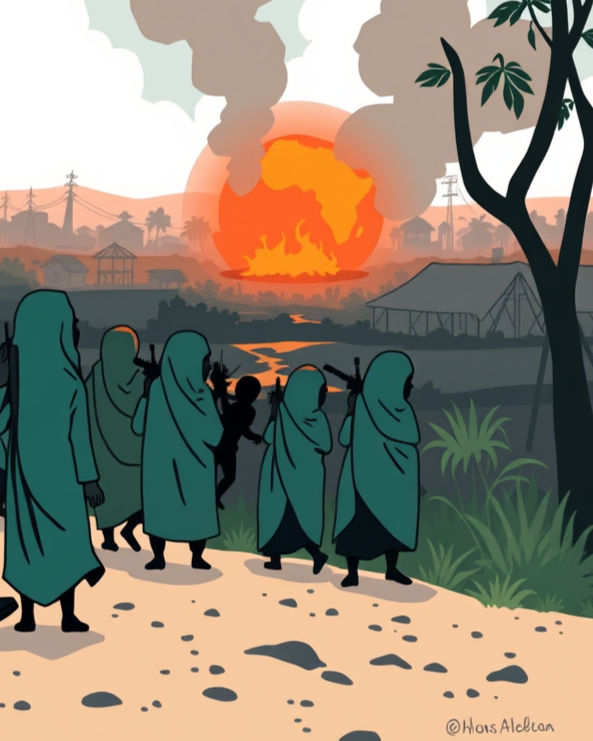
A comparison between accountability efforts in Ukraine and Myanmar reveals that perceptions of bias in ICL are often structural rather than deliberate, rooted in the architecture of state consent and the nature of international conflict. Myanmar, a Non-State Party that categorically rejected ICC jurisdiction yet committed brutal atrocities, forced the Court into legal innovation. To pursue justice for the Rohingya (a predominantly Muslim ethnic minority in Myanmar), the ICC adopted a creative and controversial interpretation of Article 12(2)(a) of the Statute, reasoning that the crime of deportation had occurred partly on the territory of Bangladesh, a State Party.[xliv] This “cross-border theory” was hailed as a bold assertion of accountability but also criticized as judicial overreach, which reveals the fragility of the system when consent is absent.
By contrast, Ukraine presents a “clean” jurisdictional model as it unambiguously accepted ICC jurisdiction through two Article 12(3) declarations in 2014 and 2015, later becoming a State Party in 2025, granting the Court authority to investigate war crimes, crimes against humanity, and genocide, on its territory.[xlv] This voluntary consent allowed for unprecedented cooperation in the form of a rapid deployment of forty-two ICC investigators in May 2022, the launch of an online evidence portal, the signing of a Joint Investigation Team agreement with Eurojust, and massive state referrals cooperation.[xlvi] Where Myanmar’s isolation forced the ICC into legal gymnastics, Ukraine’s invitation enabled logistical efficiency and swift political action. Beneath these differences lies the reality that the international legal system is biased towards protecting states from one another, not individuals from their own governments. Professors Cronin-Furman and Dayal encapsulated this reality, stating:
“there’s something else going on as well that makes Ukrainian victims more legible on the international stage than Chechen, Syrian, Tamil, Uyghur, or Rohingya…[n]amely, that international institutions and international law are built to protect states from other states, whereas those under attack from their own government have far fewer protections available to them—and far fewer willing allies.”[xlvii]
Russia’s invasion of Ukraine, a clear act of inter-state aggression, fit neatly within the existing international legal order, while Myanmar and other conflicts like in South Sudan or the Tigray region feature internal persecution, which combined with a distinct lack of state cooperation, result in less prosecutorial and political will. The differences in attention and support between both Myanmar and Ukraine reveal the reality that conflicts between states receive more attention than internal conflicts within a state. Both crises involve the denial of identity—Russia’s refusal to recognize Ukrainians as distinct mirrors Myanmar’s denial of the Rohingya—but only one drew the full mobilization of international justice due to the structural realities of ICL.
Conclusion
Ukraine represents both the apex and the limit of ICL’s ambition. The ICC’s swift action, unprecedented cooperation, and willingness to indict the leader of a major power marks a historic expansion of its reach and credibility. Yet these same achievements mark the boundaries of justice in a world still ordered by politics and power. Contrasted with Myanmar, Ukraine demonstrates what ICL can achieve when state consent, resources, and global attention align, but also exposes how rare such alignment truly is and how dependent it is on Western interests. While the ICC has issued arrest warrants for criminals in both Russia and Myanmar, none have yet been enforced, in turn conveying that the difficulty of enforcement is a common feature in ICL regardless of conflict. Nevertheless, as the Yugoslav and Rwandan tribunals validated, justice can take decades. As long as those in Ukraine and Myanmar continue to suffer, the ICC must continue to seek accountability.
From Nuremberg, Tokyo, and the post-Cold War military tribunals to the ICC’s efforts in Myanmar and Ukraine, international criminal law has taken a considerable journey from ashes to existence and experiment to reality. Justice moves slowly, even painfully at times, but its persistence is its strength. However imperfect, justice is a goal always worth pursuing.
Endnotes:
[i] International Criminal Court, “Ukraine: Situation in Ukraine”, online: <https://www.icc-cpi.int/situations/ukraine> [ICC].
[ii] Green et al, “Russia’s attack on Ukraine and the jus ad bellum” (2022) 9:1 Journal on the Use of Force and International Law at 4-7.
[iii] Sergey Vasiliev, “Aggression against Ukraine: Avenues for Accountability for Core Crimes” European Journal of International Law:Talk! (3 March 2022) online: <https://www.ejiltalk.org/aggression-against-ukraine-avenues-for-accountability-for-core-crimes/> [Vasiliev].
[iv] Ibid.
[v] ICC, supra note 1.
[vi] Miles Jackson, “The ICC Arrest Warrants against Vladimir Putin and Maria Lvova-Belova – An Outline of Issues” European Journal of International Law:Talk! (21 March 2023) online: <https://www.ejiltalk.org/the-icc-arrest-warrants-against-vladimir-putin-and-maria-lvova-belova-an-outline-of-issues/> [Jackson].
[vii] Rome Statute of the International Criminal Court, 17 July 1998, 2187 UNTS 90 (entered into force 1 July 2002), at s 8 bis (1) [Rome Statute].
[viii] Ibid at art 15 bis (5).
[ix] Ibid at art 15 ter.
[x] Vasiliev, supra note 3.
[xi] Ibid.
[xii] Ibid.
[xiii] Cecilia Ducci, “Genocide in Ukraine? The war of words and the politicization of the ‘crime of crimes’” Aspenia Online (20 May 2022) online: <https://aspeniaonline.it/genocide-in-ukraine-the-war-of-words-and-the-politicization-of-the-crime-of-crimes/>.
[xiv] Vasiliev, supra note 3.
[xv] United Nations Human Rights Council, Report of the Independent International Commission of Inquiry on Ukraine, UN Doc A/HRC/52/62 (2023) at para 95 [Human Rights Council Report].
[xvi] Ibid.
[xvii] Ibid at para 96.
[xviii] ICC, supra note 1.
[xix] Ibid.
[xx] Human Rights Council Report, supra note 15 at para 96.
[xxi] Max Du Plessis, “Pinochet, Bashir, Putin, Netanyahu, Gallant, Herzog: Immunities for High Officials – the Importance of Getting State Practice Right” European Journal of International Law:Talk! (3 October 2025) online: < https://www.ejiltalk.org/pinochet-bashir-putin-netanyahu-gallant-herzog-immunities-for-high-officials-the-importance-of-getting-state-practice-right/>.
[xxii] Jackson, supra note 6.
[xxiii] ICC, supra note 1.
[xxiv] Ibid.
[xxv] Patryk I. Labuda, “Beyond rhetoric: Interrogating the Eurocentric critique of international criminal law’s selectivity in the wake of the 2022 Ukraine invasion” (2023) 36:1 Leiden Journal of International Law at 1099 [Labuda].
[xxvi] Ibid.
[xxvii] Hitomi Takemura, The Rohingya Crisis and the International Criminal Court (Singapore: Springer Nature, 2023) at 113.
[xxviii] International Criminal Court, “Cases” online: <https://www.icc-cpi.int/cases?page=1>.
[xxix] Labuda, supra note 25 at 1102.
[xxx] Rachel López, “Black Guilt, White Guilt at the International Criminal Court” in Matiangai Sirleaf (ed), Race and National Security (Cambridge University Press 2023) at 3.
[xxxi] Ibid.
[xxxii] Edith M Lederer, “Russia and China block UN statement on Myanmar crisis” AP News (28 May 2022) online: <https://apnews.com/article/russia-ukraine-politics-asia-china-032418ad6c63394ce2968dd665f90633>.
[xxxiii] International Criminal Court, ‘Situations under investigation’ <https://www.icc-cpi.int/situations-under-investigations> accessed 2 December 2025.
[xxxiv] Labuda, supra note 25 at 1102.
[xxxv] Ibid at 1097.
[xxxvi] Ibid at 1100.
[xxxvii] Ibid at 1101.
[xxxviii] United Nations, “Sudan war and political uncertainty block progress on Abyei peace talks”, UN News (5 November 2025), online: <https://news.un.org/en/story/2025/11/1166284>.
[xxxix] Hanna Duggal, “How much of Europe’s oil and gas still comes from Russia?” Al Jazeera (3 October 2025) online: <https://www.aljazeera.com/news/2025/10/3/how-much-of-europes-oil-and-gas-still-comes-from-russia>.
[xl] Labuda, supra note 25 at 1106.
[xli] Anjali Dayal and Kate Cronin-Furman, “Russia’s Invasion Has Created Victims the World Recognizes” Foreign Policy (5 April 2022) online: <https://foreignpolicy.com/2022/04/05/russia-invasion-victims-bucha-ukraine/> [Dayal].
[xlii] Ibid
[xliii] Labuda, supra note 25 at 1104.
[xliv] Rome Statute, supra note 7 at s 12(2)(a).
[xlv] Vasiliev, supra note 3.
[xlvi] Labuda, supra note 25 at 1098.
[xlvii] Dayal, supra note 41.